Friday, February 4, 2011

Lunch


In addition to the Chawarma and the Fataaya there are plenty of small stands that sell bread filled with some mixture of meat, onion, and egg.


 This lady was selling half-baguette-sized sandwiches stuffed with skewered and grilled beef, hard-boiled egg, onion sauce, hot sauce, and mayonnaise.


Nearly everyone of these minimalist food stands looks the same, with a stack of eggs, a bottle of hot sauce and a selection of mysterious, covered tin bowls, but you never know will be thrown together.

Fataaya


In terms of fast-food, the Chawarma receives the vast majority of attention in travel literature (like Lonely Planet) because of its prevalenc on most menus across the city. However, for the real fast-food that is eaten far more universally, especially by students, one ventures to any of the many small street-side stands selling Fataaya. The favorite lunch item among students because they cost around 500 CFA and do a pretty good job of keeping you full until dinnertime. A Fataaya, from what I have gathered through my extensive experience with this item, is a triangular piece of bread that is filled with meat and onions and then fried (these are how you can spot the Fataaya stands). Upon ordering, it is cut open and filled further with French fries, a thick yassa onion sauce, a fried egg, a little pit of ketchup and hot sauce. It is then wrapped up in newspaper, ready to be inhaled. Though there is no shortage of grease packed into this lunch, it is budget friendly (at about a $1), filling, and delicious.


This is a classic Fataaya stand, the one at the University along the main student drag, which has become our go-to lunch spot.


Ouakam (USO) vs. Casa Sport


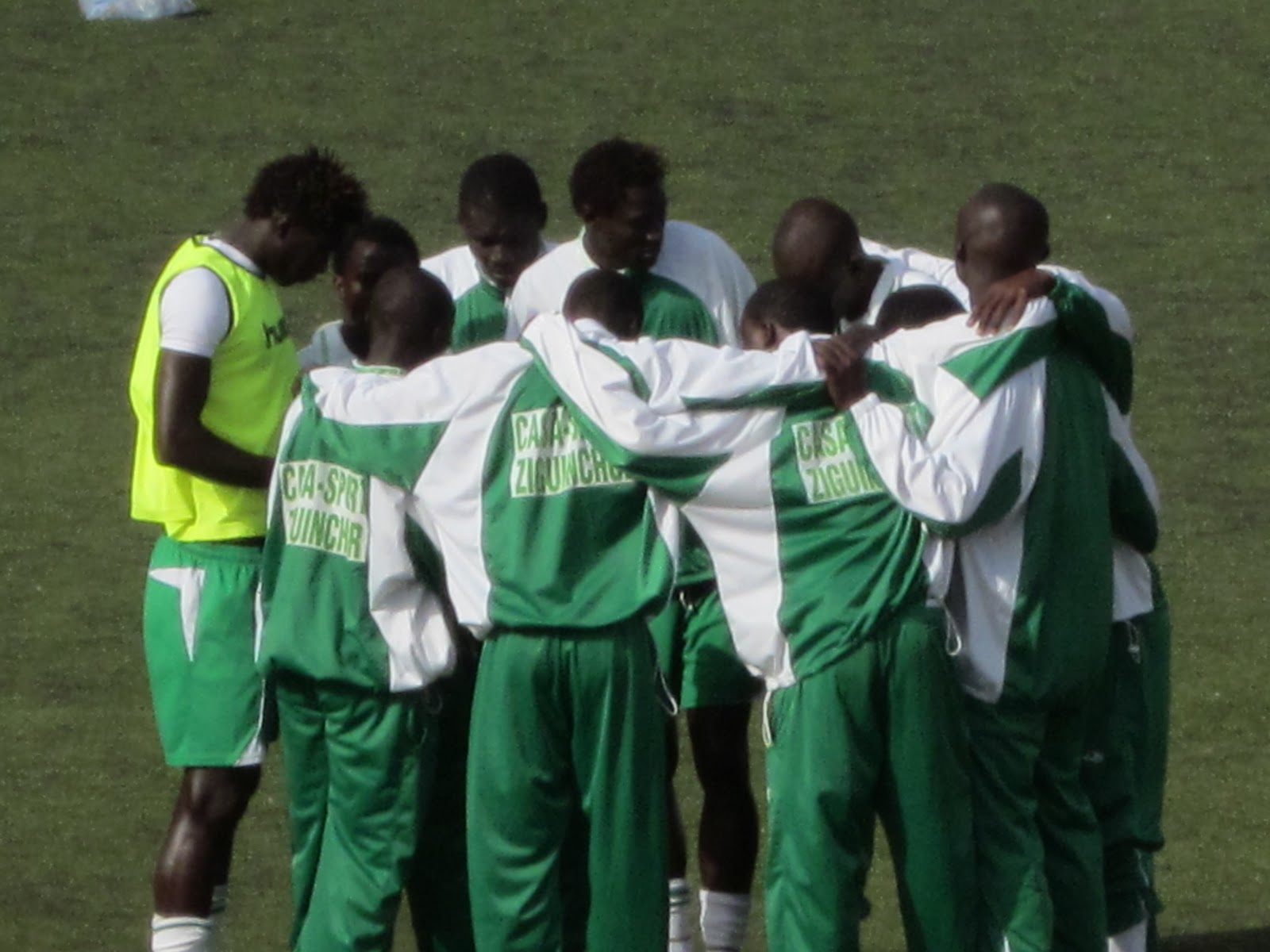
With one professional soccer game under my belt I returned to Stade Demba Diop with a new found confidence and feeling of belonging. This game I had been looking forward to since the final whistle blew last night (HLM vs. AS Pikine). This fixture featured two of the top three in the Senegalese Ligue 1, I couldn’t find an up to date table but I’m quite sure Ouakam is at the top with third place Casa Sport (from Ziguinchor, capital of Casamance in Southern Senegal). The atmosphere was accordingly more energetic and the stadium much fuller. The game itself also had the feel of a more important, more hotly contested encounter than the previous night. The referee had is hands full, and so did the stretcher crew, who had to run onto the field every time a player went down for an extended period of time. This was a pretty common occurrence in a relatively violent match such as this one, and at one point I even counted three players on the ground writhing in pain at one time from separate plays. Despite the drama it was an interesting game.

The first goal came from a warranted penalty kick decision after a Ouakam defender missed timed his challenge on a Casa Sport striker. The shot finally took place after a long ordeal that involved the referee blowing his whistle mid-approach because the linesman had noticed the goalie slightly off his line. This led to a chaotic exchange between shooter and referee and goalie and linesman, once most members of both teams got involved I thought they would just abandon the whole idea of the penalty kick and start up play by kicking into the air or something.  After the pk was buried in the upper right hand corner, we enjoyed an explosion of celebration from the Casa supporters before play resumed again.

As was the story a night before, a lack of sharpness in passing and precision and composure anywhere near goal led to many potential chances gone begging. However, tonight I was pleased to see that the defending was, on the whole, not quite as glaring problematic and the goalkeepers seemed a little bit more reliable, though distribution was more often than not somewhat mindboggling.

Ouakam’s equalizer came about 15 minutes into the second half (a rough estimate as there is no scoreboard or anything at the stadium). After a clever break into the box, a lofted cross found a head on the far post who put it over the keeper into the opposite side-netting. That gave the game a much-needed jolt however the deciding goal never came, and both teams seemed somewhat please

HLM vs. AS Pikine


It may seem surprising, and it certainly is for me, that it took three weeks to make it to my first professional soccer game here in Senegal. I will say to my credit that it was not for lack of trying. The difficulty here is locating any kind of schedule of upcoming matches. The whole time I’ve been here I’ve been scouring the internet, able only to find recaps and write-ups about past domestic matches. Even these were hard to find as most of the attention on Senegalese websites regarding sports focuses on the larger European leagues. My only success game when I started to look through the many papers available at street side kiosks. It is all in French, obviously, so it would be safe to say that trying to get some grasp of the local soccer scene has been one area where my French has been put to use quite often, and what better reward for my translation efforts then being able to watch a game! What proved to be my major breakthrough is a weekly sports paper called Stades le quotien du sport. Unfortunately, it failed to mention an African Champions League match between one of Senegal’s best teams, Jaraaf Dakar, and Gambia’s Port Authority. I had to settle for watching this game on TV, which finished as a 1-1 draw with Jaraaf equalizing in the 88th minute with an athletically executed bicycle kick. After watching that match I really got my act together and made sure I would not miss any more Senegalese soccer action.
The way it works in Dakar is there is there is a national stadium (Stade Leopold Sedhar Senghor) which is reserved for national contests and only the biggest wrestling matches, a smaller Stade Demba Diop, which hosts some large wrestling matches and most of the local professional games. There are also some smaller stadiums around that are used for less blockbuster wrestling events and Ligue 2 soccer games. Today was my second attempt at Demba Diop, the first being a frustrating and unsuccessful venture over the weekend.

Ali and I had a half hour to get from our class at Universite Cheikh Anta Diop to Stade Demba Diop. We made swiftly for the main avenue, grabbed a bus and made it there for part of the pregame warm-up. Our tickets cost CFA500, about $1, which, as we later found out, granted us access only the endline seating and not those sections along the touchline (which cost double). I tried to keep my expectations low going into the game because, due to the apparent lack of interest in local football, I thought just another midweek league fixture would not have the atmosphere I have fantasized about. Fortunately, upon my arrival, I was blown away. Granted the stadium was nowhere near capacity, the noise of singing and drumming paired with the teams various warm-up routines still gave me the chills and put a huge, inerasable smile on my face. This was what I’ve been waiting for, my first professional football match in Africa. Once the game got underway, the play itself was to some extent what I had anticipated, the defending was lackluster (to say the least) at times and the goalkeeping was very questionable throughout. However, there was no lack of entertainment value. The creativity and athleticism were there, yielding some exciting moments of brilliance, but there were also plenty of disappointing letdowns and unusual decision-making. That having been said, we got to see a great goal from AS Pikine, who dominated most of the game and, if it weren’t for a lack of final composure when on attack, should have been up by a larger margin at half.

That having been said it was a thrilling experience and one I’m sure I will relive many, many times while I’m here. Since the same stadium is used as a venue for almost all the leagues games in Dakar there are games almost every day. The next two evenings there are Ligue 1 games that I will be attending, so many more soccer posts are on the way!

Monday, January 31, 2011

Youssou N’Dour Concert


One thing I was sure about before coming to Dakar was that I was going to see Youssou N’Dour in concert. He is a legend worldwide and widely considered one of Africa’s greatest singers of all time. I couldn’t believe it only took two and half weeks for this wish to become a reality. Since I was sick for the first real weekend in Dakar this would also be my first night out. We got to the concert a little early so we were able to get some pretty good seats, which we gave up as soon as Youssou came on so we could get closer and do some dancing. The concert was incredible, more than I could have dreamed of. The venue was outside at the Institut Francais (a French cultural center in downtown where they have all sorts of events going on all the time). It was not a huge venue, but capacity was definitely met, if not exceeded. It’s tough to write about and event like this because I know that there is no way I could possibly to it justice.  

All I can say is it was incredible, such a great time. The band was energetic and sharp, and the collection of instruments gave their sound a certain complexity that was accompanied by the fantastic voice Youssou N’Dour. An unforgettable experience that I hope to relive soon.

The show featured a great mix of mbalax, afro-groove, and reggae. To my great enjoyment Youssou played quite a few songs from his new album, Dakar to Kingston, which is reggae filled compilation of tunes featuring some of reggae’s best musicians. I think most of, if not all, of the songs were recorded in studios in Jamaica. Youssou was on stage with a huge band. Of note were a great guitarist, a wild dancer, and a couple energetic drummers, who were brought to center stage on multiple occasions. For one particularly lively number Youssou shared the stage with a reggae singer whose name I was unable to catch.

Youssou played just about exactly a two hour set, which ended at around 11, so after a wearing two hours of dancing, which was interrupted from time to time by a French couple behind me who refused to stand up and dance with everyone else and asked me to sit on several occasions (this didn’t do much good for my thought of the French even though here in Senegal I think there is some rare connection between us as them as foreigners, or white people, or both) it was time to go out. We started at a pretty small bar close by, next to Ali Baba’s, where we had eaten chawarmas before he concert. There was a band doing some covers of classic reggae and Motown songs, and some people were dancing. Our group of about 8 students hitched on to a couple of Senegalese girls who were visiting from France, and we all went to a couple clubs, which were none too impressive. There was music and dancing but most of it was songs that you’d hear at a high school party and the only reason you don’t mind them all that much is that you’re drunk and girls love them, so who cares? One thing I did notice in these clubs was that there was always an entire wall that was covered in full sized mirrors. These attracted the sleeziest of the sleez-bags who would dance right in front of them, thinking perhaps that they were the star of some crappy rap video. This practice, along with having observed the amount of harassment experienced by foreign women in Dakar, has led me to believe that maybe the ratio of males to females is unnaturally unfavorable for the unfortunate men of Dakar. The night ended as everyone was getting really tired, and 

Plage des mamelles


Today we went to find another hidden beach. After a long night of dancing I was ready for some R&R on the beach. The move beach-wise started out poorly as I hopped on a bus that made every stop possible, making what usually isn’t a long trip an hour-long production. I’d never been to this part of Dakar so I was pleased that I guessed right on the bus stop and started to walk towards the water. The beach itself is not very large and it’s tucked away by a little mountain, accessible only by a garbage ridden dirt trail. I missed the trail and ended up walking to the water with a Baifal (a branch of one of the local Muslim brotherhoods, identifiable by their dreadlocks and patched clothing). I was pleased that he actually seemed pleased by my company and didn’t try to get me to buy anything. He showed me his house, which was a cool looking shack on the rocks and pointed out the beach for me.

The beach is pretty small and was, surprisingly, not very crowded. We were accompanied by only a couple other foreigners (American, Spanish, and French), a couple fishermen, and some local kids playing soccer, wrestling, participating in the typical “Dakarois” beach workout. It is a great find and I’m sure I haven’t seen the last of it.

Thursday, January 27, 2011

Yassa and Ceebu jen

Ceebu jen (or Thiéboudienne) is Senegal's national dish, which I have eaten on multiple occassions. It is always served family style at home, on a big dish with with lots of rice cooked in a tomato based sauce. Marinated fish and cooked vegetables top the rice, all of which is eaten with the hand forming balls of rice and eating them with the other items. 


Another popular food here in Dakar, served in houses and restaurants alike is Yassa. This describes an onion, lemon and mustard sauce that is served over chicen or fried fish. Also very good and versatile in it's application to nearly any type of food. In addition to the usual chicken, fish, and meat I've had Yassa on eggs and even pasta.